
Beyond the Headlines™
Mail voting
in 2026
What does the ruling mean for your ballot?
Confirm your state’s postmark and receipt deadlines. Check official election instructions.
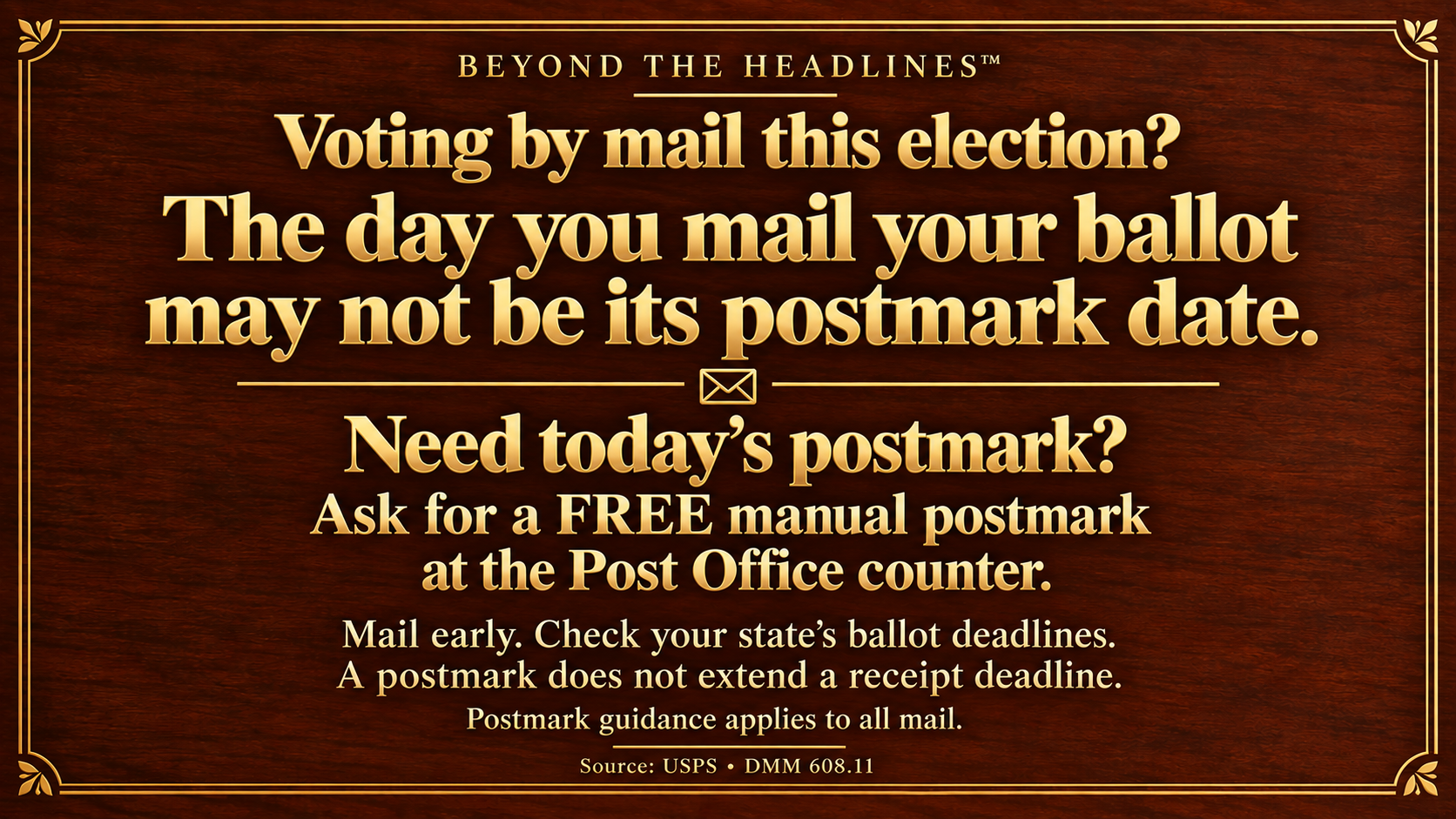
Read the postmark warning and USPS source.
Allow delivery time. Ask about local return options if time is short. Read USPS mailing guidance.
Use official tracking where available. Act promptly on problems. Check official voter guidance.
The new federal ballot-mail rule is blocked. A
separate postmark risk remains—and voters need a plan.
By Sheran Jackson | September 29, 2026
Legal status rechecked September 30, 2026.
Eligible voters can continue voting by mail under
their state’s current procedures. The U.S. Postal Service
says it is not enforcing the administration’s new
federal ballot-mail rule for the 2026 election. That
keeps these new requirements on hold; voters still
must follow the deadlines and instructions that apply
to them. USPS election-mail notice
Confirm your registration, mailing address, eligibility to vote
by mail, and ballot-request deadline. Write down both
the mailing or postmark deadline and the receipt
deadline that apply to you.
Find official state and local election information
The general election is November 3, 2026. USPS
recommends that domestic, nonmilitary voters mail completed ballots
before Election Day and at least one week
before the deadline for receipt. This is a
mailing recommendation, not an extension of state law.
Some states recommend more time.
Read USPS ballot-mailing and postmark guidance
If time is short, ask your election office
about returning your ballot directly or using an
authorized election drop box, including its closing time.
Use only options allowed in your jurisdiction. A
postal collection box is not an election drop
box. Official guidance on ballot-return options
During staffed retail hours, hand your envelope to
a clerk and request a free manual postmark.
Check that the date is correct and legible
before it leaves the counter. A lobby drop
or self-printed postage label does not provide the
same assurance. For other deadline-sensitive mail, check the
recipient’s proof requirements; a Certificate of Mailing provides
a retained record, but does not replace required
ballot postmarks or receipt deadlines.
USPS manual-postmark and mailing-proof options
Complete required signatures and any witness or notary
steps. Use official ballot tracking where available. If
the status shows a problem, contact your election
office promptly and ask what correction or replacement
options exist and when they expire.
Read the Election Assistance Commission’s mail-voting guidance
If a requested manual postmark is refused or
appears wrong, ask for a supervisor. Record the
location, date, and what happened; keep relevant receipts.
Contact USPS, and contact your election office if
a ballot deadline is at risk. Do not
let a pending complaint make you miss a
lawful return option. USPS service questions and complaints
Ask postal managers, election officials, or elected representatives
for clear warnings about postmark dates on collection
boxes and public websites, accessible return options, and
public reporting on deadline-related ballot rejections. Ask how
proposed changes will be tested and how errors
can be corrected. The ballot-mail rule’s original comment
period closed July 2, 2026; it is not
an open comment opportunity today.
Find and contact elected officials
Share your election office’s current instructions and USPS’s
free manual-postmark option, with the date you checked
them. If you want a hands-on role, ask
about poll-worker eligibility and required training.
Learn how to become a poll worker
On September 14, the Supreme Court denied the
government’s request to pause a lower-court order blocking
the rule. The case is United States Postal
Service v. California, No. 26A305. The lower-court block
therefore stayed in place.
Supreme Court order and separate opinions
This was an emergency decision during ongoing litigation.
It did not finally settle every question about
the rule’s legality. Justice Brett Kavanaugh agreed that
the rule should stay blocked because election officials
lacked enough time to carry it out for
2026, while leaving open whether USPS had authority
to adopt it. Justices Samuel Alito and Clarence
Thomas would have allowed it to proceed.
A separate USPS provision took effect December 24,
2025. It explains that a machine-applied postmark records
the first automated processing date, which may be
later than the day USPS received the envelope.
USPS describes the provision as a clarification of
existing practice. It also acknowledges that transportation changes
under its Regional Transportation Optimization program make mismatched
dates more common. USPS says those changes improve
efficiency and reduce costs.
Read the postmark rule and USPS explanation
The September court ruling did not undo this
separate provision. There is no blanket requirement to
take all mail to a counter. But depositing
an envelope in a mailbox on a deadline
does not guarantee that day’s postmark. A free
manual postmark requested at a staffed postal counter
is one way to secure the date of
acceptance.
USPS rules for postmarks and proof of mailing
Deadline safeguard: Check whether your ballot must be
postmarked by a date, received by a date,
or both. A timely postmark cannot extend a
receipt deadline.
The issue · What it means now
Its rollout remains blocked. Election offices do not
have to implement this rule for the 2026
election.
This order did not replace your state’s eligibility,
ballot-request, signature, or return requirements.
USPS still carries ballots. Voters still need to
allow delivery time and meet the applicable deadline.
The separate postmark provision remains. A mailbox deposit
and the machine-applied postmark can fall on different
days.
The emergency ruling does not decide whether these
requirements could lawfully apply in a later election.
Sources for the distinctions above: Court order ·
USPS current guidance · Federal voter guidance
President Donald Trump’s March 31 executive order directed
USPS to develop new ballot-mail standards. The administration
said better tracking and uniform safeguards would help
prevent fraud and strengthen confidence in federal elections.
The final postal rule would require election officials
to submit envelope designs for review, use specified
markings and unique barcodes, and upload recipient and
mailing data. USPS could refuse outgoing ballot mailings
that failed its requirements until errors were corrected.
This would expand its role in checking mailings
before accepting them.
Final rule on federal ballot mail
The rule also says postal workers would not
determine voter eligibility, inspect ballot choices, or count
votes. It describes checks of mailing data while
leaving voter eligibility decisions with state and local
election officials.
Jen Fifield and Peter Elkind’s September 28 investigation
describes an abandoned certified-mail proposal. Read ProPublica’s investigation
Certified mail is not a new obligation imposed
on voters by this blocked rule. The larger
USPS role described above concerns the published regulation.
States and voting-rights groups challenged the rule, arguing
that it exceeded federal authority and could disrupt
legitimate ballot delivery. Reuters reported those concerns alongside
the administration’s anti-fraud rationale and noted that evidence
of voting fraud is rare.
Reuters reporting on the ruling
An anonymous federal official, represented by Whistleblower Aid,
alleged that USPS rushed the Federal Ballot Mail
Portal and skipped needed testing. The disclosure warned
that one failed barcode check could cause an
entire batch of outgoing ballots to be returned
to the election office for correction. These are
allegations about ballots being sent to voters—not a
finding that completed votes were destroyed.
Read the whistleblower disclosure and Senate oversight letter
USPS said on September 1 that it was
reviewing the concerns and had complied with court
orders. It said the order then in place
allowed voluntary portal development and that pre-acceptance verification
was not being performed. The Supreme Court’s September
14 action later left the new mandatory rule
blocked. Read USPS’s dated response to the disclosure
Verified facts: Project 2025’s Justice Department chapter argues
for investigating and prosecuting Pennsylvania’s former election leadership
over guidance concerning rejected mail ballots. It invokes
the federal conspiracy-against-rights law, 18 U.S.C. § 241.
That is the author’s argument, not a court
finding. The March 31 executive order also invokes
that law in directing investigations of officials who
issue ballots to ineligible people.
Project 2025, printed pages 563–564 ·
Analysis: This is overlap in using federal enforcement
against election officials. The reviewed sources do not
establish that Project 2025 originated the postal portal
or the postmark provision. Similar goals alone do
not prove a direct connection.
The whistleblower’s account raises concerns about how a
proposed mailing check could affect whether voters receive
ballots in time. The separate postmark risk shows
how a routine processing step can affect ballots
sent back. Each deserves scrutiny. Neither establishes that
a local post office deliberately sabotaged a ballot;
a later postmark alone does not prove intent.
A counter visit can also be difficult for
people with limited mobility, long work hours, or
a long trip to the nearest office. Public
oversight should ask whether safeguards work in practice:
Are warnings clear? Are lawful alternatives accessible? Can
errors be corrected before deadlines?
The rule’s long-term legal future remains unresolved. The
Supreme Court’s public docket lists the September 14
denial as its latest action on this emergency
application. Follow that docket and current USPS notices
for any change; a later court order would
need its own careful reading.
The ruling also does not freeze every election
law or settle separate disputes over voter registration.
Check your state’s current guidance rather than assuming
that every procedure matches the last election.
What would fair, reliable ballot-mail service look like
in your community? What experiences with postmarks, travel
to a post office, or ballot tracking should
officials hear—and what evidence would help everyone judge
whether a proposed change improves it?
Primary sources are linked beside the claims they
support: the court order and docket, the executive
order, the published postal rule, and current USPS
and election-agency guidance. Read the court order’s first
page for the immediate ruling; the later pages
contain the dissent.
For additional explanatory reporting:
Reuters court report by Andrew Chung ·
ProPublica voter guide by Teddy Amenabar, September 16
This article provides general civic information. Your state
or local election office is the source for
instructions that apply to your ballot.
© 2026 The Bobbie and Willa Mae Jackson Foundation. All rights reserved.
Written and edited by Sheran Jackson with AI assistance. Cover artwork created with AI; editorial selection and arrangement by Sheran Jackson.
Beyond the Headlines™
What does the ruling mean for your ballot?